The net investment income tax (NIIT) is a 3.8% federal tax on investment income once your modified adjusted gross income tops $200,000. For married couples filing jointly, the line is $250,000. It sits on top of regular income tax and capital gains tax, and it’s easy to miss because it isn’t part of either bracket.
If you’re retired or close to it, the surprise is often what pulls you over the line. IRA withdrawals, required minimum distributions, and Roth conversions don’t count as investment income. They do count toward the income test, so they can bring the dividends, interest, and gains you already have under the tax.
Knowing how NIIT works can shape when you sell investments, which accounts you draw from, and how much you convert to a Roth in a given year.

What Is the Net Investment Income Tax (NIIT)?
The net investment income tax is a 3.8% federal surtax on interest, dividends, capital gains, and some other investment income. You owe it only when your income passes a set threshold. It took effect in 2013, and you figure it on IRS Form 8960.
Net investment income includes:
- Interest from savings accounts, CDs, and taxable bonds
- Dividends, including capital gain distributions from mutual funds
- Capital gains from selling stocks, bonds, funds, and investment real estate
- Rental and royalty income
- The taxable part of non-qualified annuity payments
- Income from passive business interests and from trading financial instruments or commodities
Investments that rise in value while you hold them don’t count. A gain becomes investment income when you sell. Interest and dividends count in the year you receive them, even if you reinvest them.
What Income Isn’t Subject to NIIT?
Wages, Social Security benefits, and withdrawals from IRAs, 401(k)s, 403(b)s, and 457(b) plans aren’t net investment income. The IRS also excludes tax-exempt municipal bond interest and self-employment income. The same goes for the part of a home sale gain you can exclude, up to $250,000 for single filers and $500,000 for married couples.
Excluded income can still matter. Most of it counts toward modified adjusted gross income (MAGI), the number that decides whether NIIT applies at all.
| Income source | Subject to NIIT? | Counts toward MAGI? |
|---|---|---|
| Interest and dividends in taxable accounts | Yes | Yes |
| Capital gains from selling investments | Yes | Yes |
| Net rental and royalty income | Yes | Yes |
| Traditional IRA and 401(k) withdrawals, including RMDs | No | Yes |
| Roth conversions | No | Yes |
| Qualified Roth IRA withdrawals | No | No |
| Social Security benefits | No | The taxable part |
| Wages | No | Yes |
| Tax-exempt municipal bond interest | No | No |
| Home sale gain within the exclusion | No | No |
Source: IRS, Questions and Answers on the Net Investment Income Tax and Topic 559.
Who Has to Pay the NIIT?
You owe NIIT if you have net investment income and your MAGI is above the threshold for your filing status. For most people, MAGI for this tax is the same as adjusted gross income.
| Filing status | NIIT threshold (MAGI) |
|---|---|
| Single | $200,000 |
| Head of household | $200,000 |
| Married filing jointly | $250,000 |
| Qualifying surviving spouse | $250,000 |
| Married filing separately | $125,000 |
Source: IRS, Net Investment Income Tax.
These thresholds haven’t changed since 2013 because they aren’t indexed for inflation. Regular tax brackets rise each year, so more households cross the NIIT line as incomes and investment balances grow.
How Is NIIT Calculated?
NIIT equals 3.8% of the smaller of two numbers: your net investment income, or the amount your MAGI exceeds the threshold.
NIIT = 3.8% × the lesser of net investment income or MAGI above the threshold
Example: A Married Couple With Investment Gains
A married couple filing jointly has $280,000 of MAGI, including $50,000 of net investment income. Their MAGI is $30,000 over the $250,000 threshold. Since $30,000 is smaller than $50,000, NIIT applies to $30,000: $30,000 × 3.8% = $1,140.
That $1,140 comes on top of their regular tax on the same income. It’s far less than 3.8% of their total income, or even of all their investment income.
NIIT also falls under the estimated tax rules. A large sale late in the year can call for a bigger quarterly payment or more withholding to avoid an underpayment penalty.
How Does NIIT Change Your Capital Gains Tax Rate?
NIIT adds 3.8 percentage points to the capital gains tax on gains it reaches. Long-term gains, on investments held more than a year, are taxed at 0%, 15%, or 20%. In the 20% bracket, NIIT brings the federal rate to 23.8% before any state tax. Short-term gains are taxed as ordinary income and can owe NIIT too.
Why Does Cost Basis Matter?
Only the gain counts. If you bought shares for $60,000 and sell them for $100,000, your cost basis is $60,000 and your gain is $40,000. That $40,000 goes toward net investment income, not the full $100,000.
Can NIIT Apply If You Don’t Sell Anything?
NIIT can apply without a sale. Interest, dividends, and the capital gain distributions mutual funds pay out each year all count, even when you hold every share. Funds that trade often distribute more of their gains.
Can a Roth Conversion Trigger NIIT?
A Roth conversion can trigger NIIT indirectly. The converted amount counts as ordinary income, which raises your MAGI. That can push the investment income you already have over the threshold.
Example: A Roth Conversion That Crosses the Line
A married couple has $220,000 of MAGI, including $40,000 of net investment income. They’re $30,000 under the threshold and owe no NIIT.
They convert $100,000 to a Roth. MAGI rises to $320,000, or $70,000 over the threshold. NIIT applies to the smaller amount, their $40,000 of investment income: $40,000 × 3.8% = $1,520.
That $1,520 comes on top of the income tax on the conversion. Selling taxable investments to pay the conversion tax can add capital gains and more NIIT. A conversion can still pay off over a lifetime. Weigh it alongside the other costs a conversion can raise, such as Medicare surcharges.
How Can You Reduce the Net Investment Income Tax?
You can reduce NIIT by keeping MAGI under the threshold in the years you realize investment income, or by shrinking the investment income itself. Six moves help.
1. Spread Out Capital Gains
Selling over two or three tax years can keep each year’s MAGI lower. The years after you retire and before Social Security and required minimum distributions start often leave the most room.
2. Harvest Losses
Selling investments at a loss offsets realized gains, which lowers net investment income. The wash-sale rule disallows the loss if you buy the same or a substantially identical investment within 30 days before or after the sale.
3. Hold Tax-Efficient Investments
Municipal bond interest is exempt from NIIT and from federal income tax. Index funds and ETFs with low turnover distribute fewer capital gains than many actively managed funds. Returns, risk, and diversification still come first.
4. Size Roth Conversions
Splitting a Roth conversion across several years can keep MAGI under the threshold or limit how far over it you go. A conversion that triggers some NIIT can still be the right move if it saves more tax later.
5. Choose Which Accounts to Draw From
Traditional IRA and 401(k) withdrawals raise MAGI. Qualified Roth withdrawals don’t. Selling taxable investments raises both MAGI and net investment income. The order you draw from accounts decides how much of each you report in a given year.
6. Give Appreciated Shares or Use QCDs
Donating appreciated shares to charity avoids the capital gain on those shares. At 70½ and older, a qualified charitable distribution sends IRA money straight to charity. It stays out of your adjusted gross income, which keeps MAGI lower.
How Does Boldin Model NIIT?
The Boldin Planner includes NIIT in your federal tax projections for every year of your plan, using the IRS thresholds. It applies the 3.8% to:
- Interest
- Qualified dividends
- Capital gains on sales from taxable accounts, based on your cost basis
- Capital gain distributions, based on the turnover rate you enter
You’ll find NIIT on the Insight > Taxes page. The Planner also adds it to your estimated tax payments on the Insight > Estimated Expenses page.
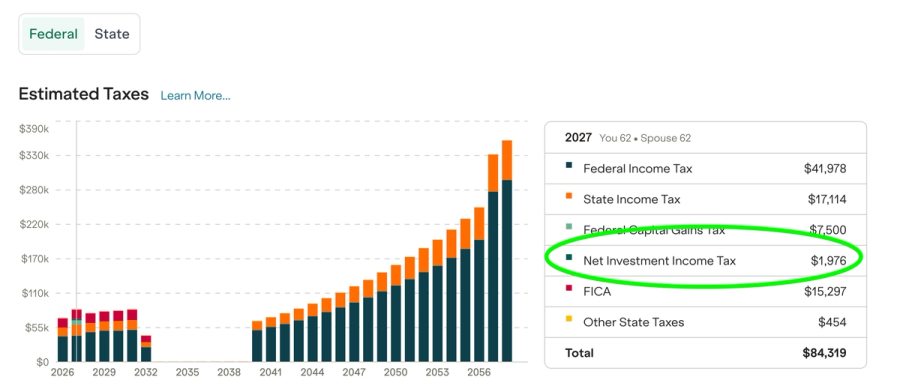
The Planner doesn’t apply NIIT to rent or royalties, a home sale gain above the exclusion, non-qualified deferred compensation, or non-qualified annuity income. If you expect large amounts of those, estimate NIIT separately on Form 8960 or with a tax professional.
Add Your Cost Basis
Enter the cost basis for each taxable account. Without it, the Planner can’t separate what you invested from what you gained, so its capital gains and NIIT estimates are less precise.
In the Boldin Planner, you can test a Roth conversion or a new withdrawal order. You’ll see how each one changes your projected taxes, including NIIT, year by year.
NIIT Is One Piece of Your Total Tax Bill
NIIT seldom decides a financial move on its own. It interacts with capital gains rates, Roth conversions, RMDs, and Medicare premiums. The cheapest choice this year can cost more over 20 years, which is why retirement tax planning works best across your whole plan.
Net Investment Income Tax FAQ
What does NIIT stand for?
NIIT stands for net investment income tax, a 3.8% federal tax on investment income such as interest, dividends, capital gains, and rent. It applies when modified adjusted gross income exceeds $200,000 for single filers or $250,000 for married couples filing jointly. The tax is reported on IRS Form 8960.
What are the NIIT thresholds for 2026?
The NIIT thresholds for 2026 are $200,000 of MAGI for single and head-of-household filers and $250,000 for married couples filing jointly. Married people filing separately have a $125,000 threshold. The thresholds date to 2013 and aren’t adjusted for inflation, so they stay the same each year.
Is NIIT the same as capital gains tax?
The net investment income tax is a separate tax that applies on top of capital gains tax. A gain taxed at the 20% long-term capital gains rate can owe another 3.8% in NIIT, for a 23.8% federal rate. NIIT also reaches interest and rental income, which aren’t capital gains.
Do RMDs count toward NIIT?
Required minimum distributions aren’t subject to NIIT, since IRA and 401(k) withdrawals don’t count as net investment income. An RMD does raise your modified adjusted gross income. That can push your dividends, interest, and capital gains over the NIIT threshold in the same year.
Do Roth conversions trigger NIIT?
A Roth conversion isn’t subject to NIIT itself. The converted amount counts as ordinary income, which raises modified adjusted gross income. If that pushes MAGI over $200,000, or $250,000 for married couples, your other investment income can owe the 3.8% tax for that year.
How can retirees reduce NIIT?
Retirees can reduce NIIT by spreading capital gains across tax years and harvesting losses. Holding municipal bonds or low-turnover funds in taxable accounts helps, as does sizing Roth conversions to stay under the threshold. Qualified charitable distributions at 70½ and older also keep IRA money out of adjusted gross income.
This article is for educational purposes and isn’t individualized tax or investment advice. Tax rules and personal circumstances vary, so consult a qualified tax professional before making major financial decisions.