Retirement Savings and Investments
Average and Median 401(k) Balance by Age (2026 Data)
The average 401(k) balance is $167,970, but the median is $44,115. See both by age, plus percentiles and Fidelity’s newer data, to see where you stand.
There are a lot of questions about retirement savings and investments.
With regards to savings, you need to know: How much to save (did you know that some people save too much)? How much savings you will you need for retirement? Where should you save? Should you save pre-tax (traditional, SEP & Simple IRAs, 401ks, 403bs, 457s, 529s, HSAs, etc…) or after-tax (Roth IRAs and 401ks)? How do you find more money to save?
And, there are probably even more questions about investments: What should you invest in (stocks, bonds, real estate, funds)? How should your investments change over time? How do your financial values impact your investment strategy? What is the ideal asset allocation for you? What should you do when the market swings wildly?
See below for articles covering the answers to these questions and more.
The average 401(k) balance is $167,970, but the median is $44,115. See both by age, plus percentiles and Fidelity’s newer data, to see where you stand.
How to sort your holdings into 7 asset classes, spot concentration risk, check against your risk profile, and catch drift or cash drag early.
Under-saving is a math problem you can still fix. Over-saving can cost years you won’t get back. Here’s how to tell which one you’re doing.
Split your retirement savings into cash, bonds, and stocks by when you’ll spend it. Here’s how to calculate each bucket and keep them filled.
Sequence of returns risk is how the order of your returns affects the savings you withdraw. See a 15-year example and six ways to protect your retirement.
Two 2026 surveys put the number at $1.2 million and $1.46 million, $260,000 apart. Here’s why, and how to find your number.
Two CFP® professionals answer real questions on Roth conversion timing, the pro rata rule, and avoiding surprise Medicare or ACA costs.
J.P. Morgan research found 84% of retirees never draw more than the RMD minimum. Here’s how to tell if that’s the right move for you.
Consumption smoothing is how you keep your standard of living stable across a lifetime of income changes, career shifts, and retirement.
Beyond the free $1,000, funding a Trump Account can leave your child with less post-tax than a brokerage account, unless you get the Roth conversion right.
Inheriting money? Won the lottery? Here is what you need to know for long-term financial security after experiencing a sudden wealth event.
A $150,000 gift can cost $360,000 in retirement terms. Here’s the opportunity cost math, gift tax rules, and four ways to structure the help.
A 1% S&P 500 dividend yield leaves an income gap in retirement. An income floor can bridge it, and a Treasury ladder can help build it.
Morningstar puts the safe withdrawal rate at 3.9%, but flexible strategies can push it to 5.7%. Seven takeaways and what they mean for you.
Vanguard’s new target-date trusts put guaranteed income inside your 401(k). But a floor isn’t a plan. Here’s what the product can’t tell you.
Balanced funds simplify investing while you’re saving. But proportional withdrawals can limit flexibility in retirement when it matters most.
Run the Dave Ramsey retirement calculator math at his 11% return and a lower one, then see what his 8% withdrawal rule means for your target.
Five penalty-free ways to tap your 401(k) or IRA before 59½. How SEPP, the Rule of 55, Roth withdrawals, and two more exceptions work.
After 50, you can put up to $34,000 in a 401(k) and $8,600 in an IRA in 2027. See the 2026 and 2027 catch-up limits at every age.
Use 6–8% while you’re saving for retirement, 5–6% while you’re withdrawing. The right rate depends on your asset mix and timeline.
Learn how CalSavers applies to California workers and employers, including automatic Roth IRA enrollment, payroll deductions, and benefits.
The contribution order for retirement accounts can affect how much your money compounds tax-free. Here’s how to prioritize for tax efficiency.
Money is not all about numbers and analysis. Emotions can help and hurt your financial security. Learn how to be an emotionally intelligent investor.
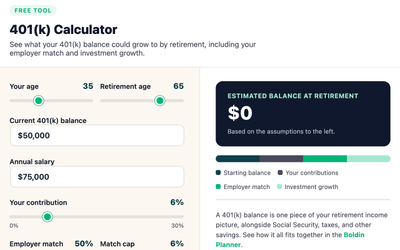
See your projected 401(k) balance in seconds, employer match included, using 2027 contribution limits. Free calculator, no email required.
Take financial wellness into your own hands and do it yourself retirement planning: easy, comprehensive, reliable.