A Roth conversion in a market downturn costs less in taxes. When share prices fall, you can move the same shares into a Roth for less taxable income. Any recovery then happens inside the Roth, tax-free.
That’s hard to see while your balances are shrinking. In a falling market, most people’s instinct is to wait it out, and the window can close before they notice it was open.
“When markets are down, it’s hard to avoid the noise, and people have a natural tendency to want to do something versus just watch their balances decline,” says Mike Pappis, a CFP® professional and Head of Support at Boldin. “One of those potential things is looking into a Roth conversion to take advantage of lower valuations.”

What Are the Benefits of a Roth Conversion in a Market Downturn?
The main benefit is a smaller tax bill for the same position. Say you want to convert 200 shares of an index fund. At $60 a share, that adds $12,000 to your taxable income. After a 20% drop to $48, the same 200 shares add $9,600, or $2,400 less.
The shares don’t change when they move. If the fund climbs back to $60, the $2,400 of recovery belongs to the Roth, where it grows and comes out tax-free. Shares that leave your traditional IRA also stop feeding future required minimum distributions.
The opening lasts only as long as prices stay low, which makes it one of the few upsides of market volatility. Once the market recovers, the same conversion costs full price again.
Is It Better to Do a Roth Conversion When the Market Is Up or Down?
A down market lowers the tax cost of each share you convert. Your tax bracket still matters more: converting at 12% in a flat market can beat converting at 32% after a crash. The market discount works best as a bonus on a conversion you’d make anyway.
“If a conversion makes sense for someone in a good market, a downturn is a real opportunity to act on it as a planning opportunity,” Mike says.
“People tend to overthink the timing of Roth conversions,” he adds. “There’s no perfect month and it doesn’t have to be an all-or-nothing decision. Spreading conversions out can give you more flexibility than trying to get it exactly right.”
Who Should Consider a Down-Market Roth Conversion?
Down-market conversions fit best in the gap between leaving work and starting Social Security or RMDs. Income often drops in those years, so the lower tax brackets have room, and the Roth has years to grow before you need it. A market dip during those years adds a second discount to the first.
The case is harder during peak earning years. A conversion adds to income already taxed at a high rate, and the market discount seldom makes up the difference.
Three questions help sort it out:
- Are you in a lower tax bracket this year than you expect to be later?
- Do you have room to convert without crossing into a higher bracket?
- Do you have cash outside your IRA to cover the tax?
If all three answers are yes, a down market strengthens the case.
How Much Should You Convert?
A common approach is to convert enough to fill a target bracket without crossing into the next one. For married couples filing jointly, the 22% bracket runs to $211,400 of taxable income in 2026 and $218,250 in 2027:
| Taxable Income Before Converting (Joint) | Room Left in 22%, 2026 | Room Left in 22%, 2027 |
|---|---|---|
| $130,000 | $81,400 | $88,250 |
| $160,000 | $51,400 | $58,250 |
| $185,000 | $26,400 | $33,250 |
Source: Boldin calculations from IRS Rev. Proc. 2025-32 and Rev. Proc. 2026-35.
How much makes sense also depends on where your income is headed and your mix of pre-tax and Roth money. The size of your future RMDs matters too. If you’re 65 or older, conversion income can also shrink the $6,000 senior deduction.
“It’s really about looking at their total situation,” Mike says. “Income for the year, what tax bracket they’re currently in, and their current tax rate versus their future rate. If someone’s projected to be in a lower bracket today than when they’ll take that money out in the future, then that’s where a Roth conversion can potentially make sense.”
What Are the Risks of Converting in a Downturn?
The biggest risk is that prices keep falling after you convert. A conversion can’t be undone, since the IRS ended recharacterizations in 2018. You’d owe tax on a higher value than the shares now hold. Converting in pieces across several months or years spreads that risk across different prices.
If you collect Social Security, conversion income counts toward the combined income that decides how much of your benefit is taxable. A large conversion can push that share up to 85%.
Medicare’s IRMAA surcharges use your income from two years earlier. For 2026, surcharges start above $109,000 of 2024 income for single filers. For joint filers, the line is $218,000. A conversion this year affects your premiums two years out, against thresholds that rise with inflation.
The pro-rata rule applies if your traditional, SEP, or SIMPLE IRAs hold any after-tax money. The IRS treats each conversion as a slice of your combined year-end balance, so you can’t convert only the after-tax part.
Paying the tax out of the conversion shrinks what reaches the Roth. If you’re under 59½, the amount withheld also counts as an early distribution and can owe the 10% additional tax.
“A common mistake I see is people paying the taxes from the conversion itself, especially if they have outside money available,” Mike says. “Paying for the taxes from the conversion itself reduces the amount that actually makes it into the Roth,” he says. “It undermines the whole strategy.”
Other income can stack on top of a conversion too. A home sale, a rebalance in a taxable account, or a large IRA withdrawal in the same year can push you past a bracket or an IRMAA line.
What Are the Roth Conversion Rules for 2026?
Roth conversions have no income limit and no dollar cap. The converted amount is added to your ordinary income for the year and taxed at your regular rates.
Direct Roth IRA contributions follow other rules. For 2026 and 2027, you can contribute up to $7,500, or $8,600 at 50 or older. In 2027, single filers phase out between $158,000 and $173,000 of modified AGI, and joint filers between $250,000 and $260,000. The 2026 ranges are $153,000 to $168,000 and $242,000 to $252,000.
Each conversion starts its own five-year clock on January 1 of the year you convert. If you’re under 59½ and withdraw converted money within those five years, you owe a 10% additional tax on it. Income tax was already paid at conversion.
How Can You Model a Down-Market Conversion?
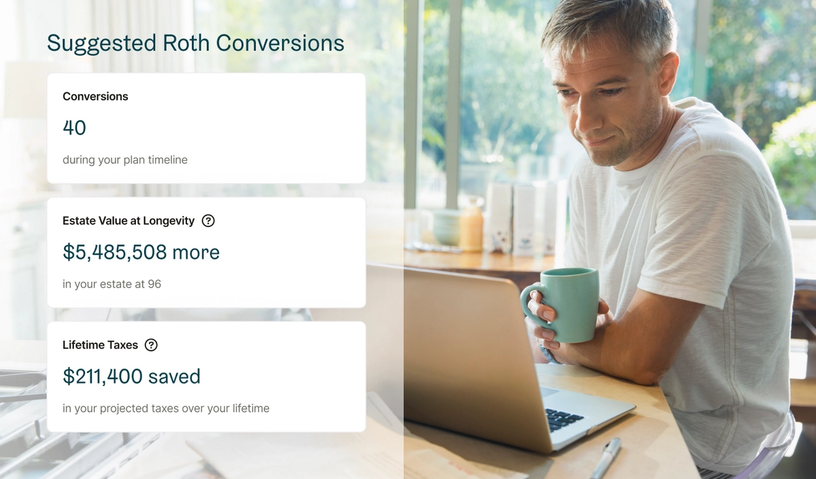
The Roth Conversion Explorer in the Boldin Planner tests conversion amounts against your projected tax bill, RMD schedule, and long-term plan. You can see each amount alongside your Social Security timing and tax projections.
Scenarios let you compare two or three conversion amounts side by side over 10 or 20 years. In a 2025 survey of Boldin subscribers, 83% said they use Boldin’s Roth conversion tools to plan conversions over multiple years.
Roth Conversion in a Market Downturn FAQ
Is a Roth conversion a good idea when the market is down?
A Roth conversion in a down market lowers the tax on each share you move, and any recovery happens tax-free inside the Roth. It’s a good idea when your tax rate now is lower than you expect later. You also need cash outside the IRA to pay the tax. The market drop alone doesn’t make the case.
What happens if the market keeps falling after I convert?
A Roth conversion can’t be reversed, so if prices keep dropping, you’ve paid tax on a higher value than the account now holds. The shares can still recover inside the Roth. Splitting the conversion into smaller amounts, months apart, means no single price sets the whole tax bill.
Should I convert stocks or cash in a down market?
Converting shares that have fallen gets more out of a downturn than converting cash. Cash in an IRA hasn’t lost value, so it carries no discount. Most custodians let you convert shares in kind, without selling them, so the same holdings recover inside the Roth.
Can I convert part of my IRA?
Partial Roth conversions are allowed, with no minimum or maximum. Many retirees convert a set amount each year, enough to fill a target bracket, and repeat it over several years. Spreading conversions out spreads the tax bill and helps keep Medicare surcharges and Social Security taxes in check.
How do I pay the tax on a Roth conversion?
The tax on a Roth conversion can go in a quarterly estimated payment for the quarter you convert. You can also raise withholding from a pension, paycheck, or Social Security. The IRS treats withholding as paid evenly through the year. Either way, paying from outside the IRA keeps the full amount in the Roth.
Does a Roth conversion count as income for Social Security?
Roth conversion income is part of the formula the IRS uses to tax Social Security, which adds AGI, tax-exempt interest, and half your benefits. The conversion doesn’t reduce your benefit or count as earnings under the Social Security earnings test. A large one can make more of your benefit taxable that year.