A retiree drawing $80,000 a year from a traditional IRA in California pays roughly $3,500 more in state income tax than the same retiree in Florida, who pays nothing. For anyone deciding where to spend their post-career years, choosing a tax-friendly state offers a meaningful, long-term financial advantage. This guide covers the most tax-friendly states for retirees across income, Social Security, property, and sales taxes to help evaluate the full tradeoff.
Nine states have no broad-based individual income tax on wages or retirement accounts: Alaska, Florida, Nevada, New Hampshire, South Dakota, Tennessee, Texas, Washington, and Wyoming. For retirees strategizing taxes, that means pension income, IRA withdrawals, and Social Security benefits face zero state income tax.
Income tax is only part of the picture, though. High sales taxes and property levies can quickly offset the benefit of a zero-income-tax baseline. The table below compares the top 10 states across all major categories.

How the Top 10 States Compare Across Five Tax Categories
Wyoming, South Dakota, and Florida lead when retirement tax friendliness is scored across all dimensions: income tax, Social Security taxation, pension taxation, sales tax, and property tax.
| State | Income Tax Rate | Taxes Social Security? | Taxes Pension Income? | Avg. Combined Sales Tax | Avg. Effective Property Tax |
|---|---|---|---|---|---|
| Wyoming | None | No | No | ~5.56% | ~0.58% |
| South Dakota | None | No | No | ~6.11% | ~0.99% |
| Florida | None | No | No | ~7.00% | ~0.83% |
| Alaska | None | No | No | ~1.82% (local only) | ~0.94% |
| Nevada | None | No | No | ~8.24% | ~0.49% |
| Tennessee | None | No | No | ~9.61% | ~0.49% |
| Texas | None | No | No | ~8.20% | ~1.40% |
| New Hampshire | None | No | No | None | ~1.50% |
| Mississippi | 4.00% flat | No | No | ~7.06% | ~0.58% |
| Illinois | 4.95% flat | No | No (qualified plans) | ~8.82% | ~1.88% |
Sources: Tax Foundation 2026 State Income Tax Rates; Tax Foundation State and Local Sales Tax Rates; Tax Foundation Property Taxes by State and County.
Note: Washington tiers its high-earner investment taxes but does not tax regular retirement distributions. Illinois features a high property tax rate that partially offsets its retirement income exemptions.
States to Avoid for Retirement Taxes
New York, California, and Hawaii consistently rank as the highest-burden states for retirees, according to both the Tax Foundation and U.S. News & World Report.
New York combines a 10.9% top income tax rate with estate taxes and an average effective property tax rate near 1.60%. California’s top marginal income tax rate hits 13.3%, the highest in the country. While California does exempt Social Security benefits, standard traditional IRA withdrawals and wages face full taxation.
Hawaii’s total burden runs high despite having the nation’s lowest effective property tax rate. The state depends on a broad general excise tax applied at every stage of the transaction chain, which heavily drives up the everyday cost of goods and services for seniors on a fixed budget.
What Types of Taxes Should Retirees Think About?
State taxes in retirement fall into six categories: income tax, interest and dividends tax, sales tax, property tax, estate tax, and taxes on Social Security and pension income. Not every state levies all six.
- State Income Tax: Usually the biggest concern. Rates range from zero to 13.3%.
- Interest and Dividends: New Hampshire has fully phased out its investment income tax, but asset location still matters across remaining states that tax unearned income.
- Sales Taxes: A combination of state and local rates. Five states have no statewide sales tax.
- Property Taxes: Effective rates range from under 0.30% to nearly 1.90% depending on the specific municipality.
- Estate Taxes: Most states have eliminated these, but 12 states and D.C. still impose them.
- Taxes on Social Security and Pensions: Most states don’t tax either, but a handful maintain partial or full taxes on high-income benefits.
What State Taxes Cost Retirees Each Year
State taxes can reduce retirement spending power by several thousand dollars a year. A retiree living on Social Security and a modest pension in Connecticut pays significantly more in state tax than the same retiree in Mississippi, even accounting for Mississippi’s 4.00% flat rate. The net impact depends heavily on your primary income source.
Some states tax retirement income at rates above 10%, while others charge nothing. A handful of states treat Social Security, pensions, and account withdrawals differently from standard W-2 wages. Those differences compound dramatically across a 20- or 30-year retirement horizon.
Housing costs, healthcare access, and climate risk often carry more weight than state taxes alone. Moving purely for tax reasons doesn’t always deliver the structural savings you’d expect once those regional factors are counted. Evaluate taxes as one piece of your complete financial plan, looking at how different locations affect spending, income, and lifestyle collectively. For the overall picture, see how the major rankings compare the best states to retire.
States With the Highest and Lowest Overall Tax Burden
Overall tax burden measures what all residents pay across income, sales, property, and other taxes as a share of personal income. Two major national analyses use different methodologies and reach slightly different conclusions about which states rank best and worst.
U.S. News & World Report calculated the overall tax burden for all 50 states using total state and local tax revenues as a share of personal income via Census Bureau and Bureau of Economic Analysis (BEA) data.
The Tax Foundation’s 2026 State Tax Competitiveness Index focuses on structurally competitive tax frameworks and reaches different conclusions based on legal tax design.
Lowest overall tax burden (U.S. News ranking):
- South Dakota
- Florida
- New Hampshire
- Tennessee
- Wyoming
Lowest overall tax burden (Tax Foundation ranking):
Wyoming, South Dakota, New Hampshire, Alaska, Florida, Montana, Texas, Tennessee, Idaho, and Indiana.
Highest overall tax burden (U.S. News ranking):
- New York
- Hawaii
- New Mexico
- California
- Vermont
Highest overall tax burden (Tax Foundation ranking):
Hawaii, Vermont, Massachusetts, Minnesota, Washington, Maryland, Connecticut, California, New Jersey, and New York.
States With No Income Tax: What Retirees Need to Know
Washington stands out among the nine states with no income tax. It taxes long-term capital gains at 7% above an inflation-adjusted $278,000 deduction, with a 9.9% surtax on capital gains above $1 million. The legislature also enacted a new 9.9% income tax on high earners making over $1 million, which is scheduled to take effect in 2028. Retirees with large investment portfolios should factor that in before relocating.
The other eight states charge nothing on pension income, IRA withdrawals, or Social Security. Together, all nine are:
Alaska, Florida, Nevada, New Hampshire, South Dakota, Tennessee, Texas, Washington, Wyoming
Several other states keep flat or low rates that still offer a meaningful advantage. According to the Tax Foundation:
Lowest-rate income tax states:
- Arizona: 2.5% flat
- North Dakota: 2.5%
- Ohio: 2.75% max
- Indiana: 2.95% flat
- Louisiana: 3.0% flat
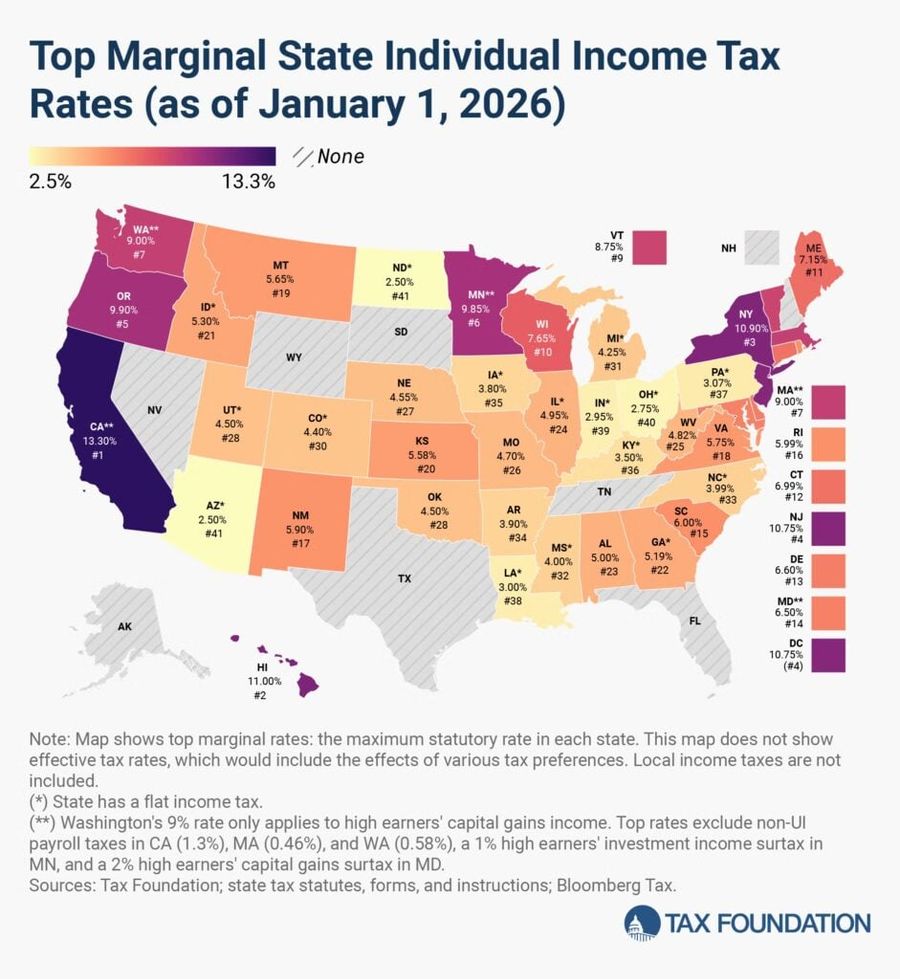
California has the highest top rate at 13.3%, followed by Hawaii (11%) and New York (10.9%).
Find your state’s income tax rate on the map below:
Which States Tax Social Security Benefits?
Most states don’t tax Social Security benefits. Only eight states impose a Social Security income tax, and most offer generous full or partial exemptions based on income thresholds.
Those eight states are: Colorado, Connecticut, Minnesota, Montana, New Mexico, Rhode Island, Utah, and Vermont. (West Virginia has fully phased out its Social Security tax).
Most of these states follow federal exemption thresholds or apply separate income-based limits. In Minnesota, individual filers with adjusted gross incomes up to $86,410 owe no state tax on Social Security; the exemption phases out gradually above $126,410. In New Mexico, benefits are fully deductible for individuals with AGIs below $100,000.
For current guidance, see the SSA’s official benefit taxation page and the Tax Foundation’s state-by-state breakdown.
Which States Don’t Tax Pension Income?
More than a dozen states exempt pension income from state taxes, including all nine no-income-tax states plus Alabama, Illinois, Mississippi, and Pennsylvania.
States with no tax on pension income include:
- No income tax at all (pension exempt by default): Alaska, Florida, Nevada, New Hampshire, South Dakota, Tennessee, Texas, Washington, Wyoming
- Income tax but full pension exemption: Alabama (private, military, and government pensions), Illinois (qualified employee benefit plans), Mississippi, Pennsylvania
States with partial exemptions or complex rules include Georgia, Kentucky, New York, and several others. Check your state’s revenue agency for details, since exemption rules vary heavily by pension type.
Sales Tax Rates by State: What Retirees Spend Matters Too
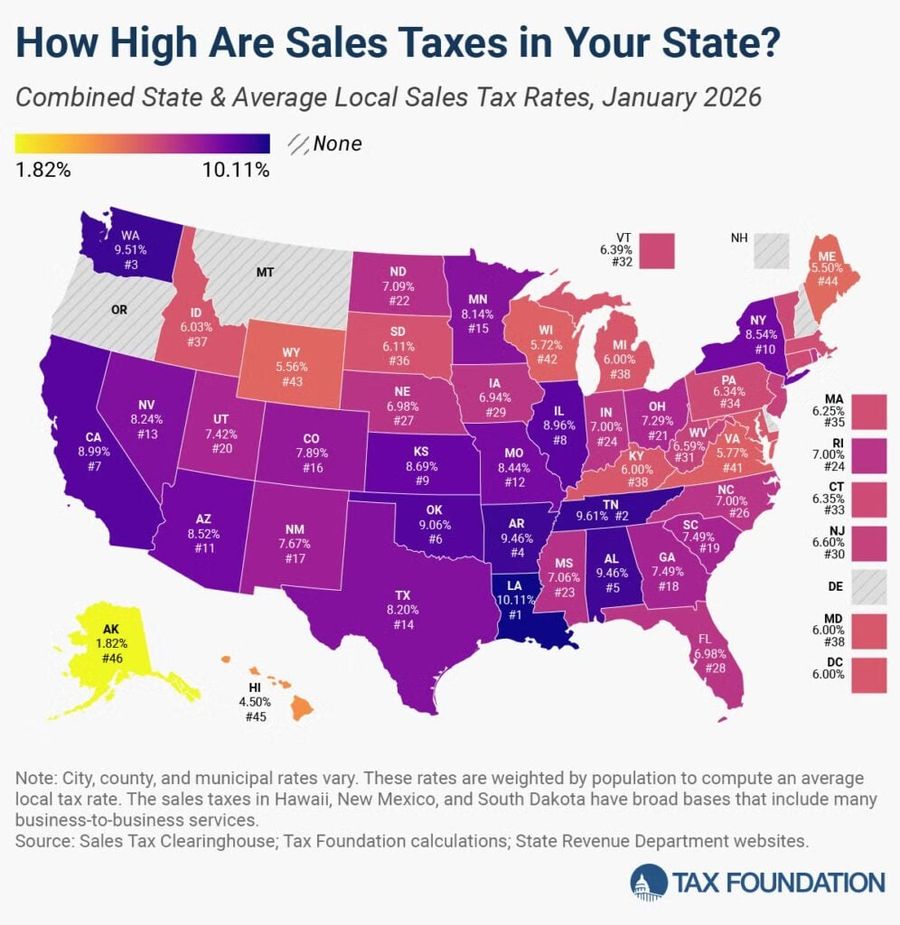
Five states charge no statewide sales tax at all: Oregon, Montana, New Hampshire, Delaware, and Alaska. Louisiana sits at the other end with a combined state and average local rate of 10.12%, the highest in the country.
Sales taxes add up quickly on a fixed income. According to the Tax Foundation, 45 states levy a state-level sales tax and 38 allow local sales taxes on top.
Highest combined state and local sales tax rates:
- Louisiana: 10.12%
- Tennessee: 9.61%
- Washington: 9.51%
- Arkansas: 9.46%
- Alabama: 9.46%
States with no statewide sales tax: Oregon, Montana, New Hampshire, Delaware, and Alaska (no statewide tax, though local rates apply in most Alaskan municipalities).
Find your state’s combined sales tax rate on the map below:
Property Tax Rates by State
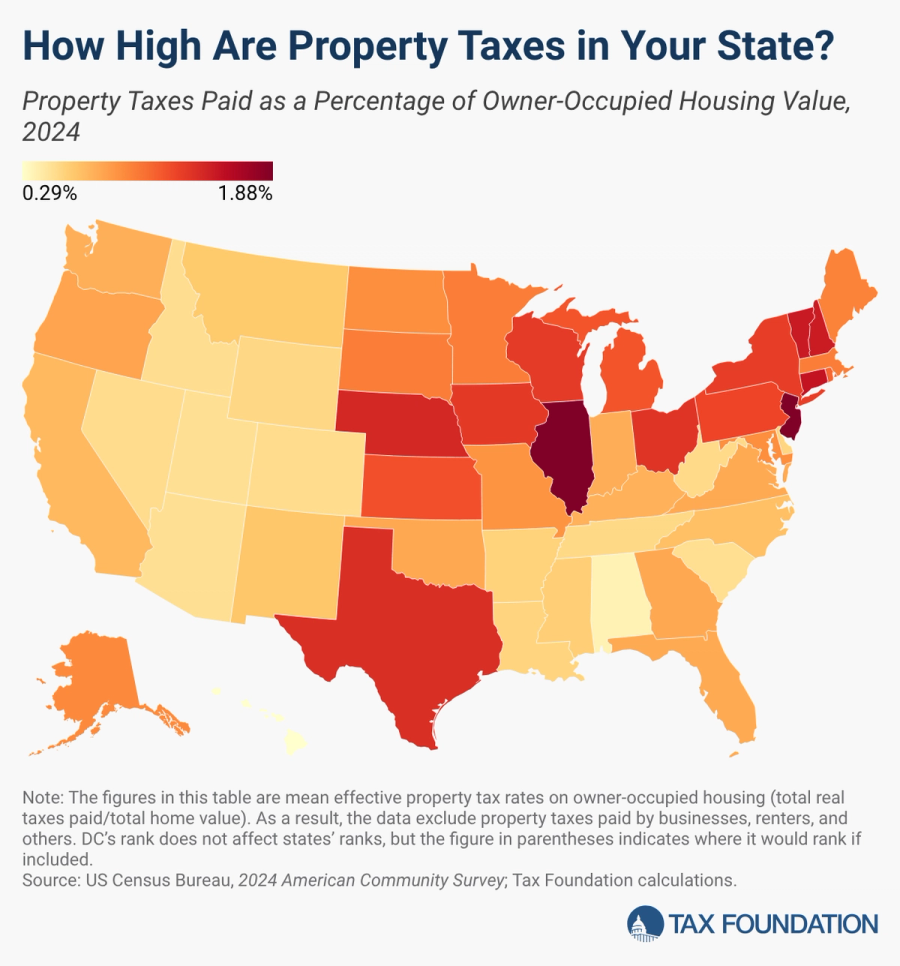
Effective property tax rates span from roughly 0.29% in Hawaii to nearly 1.88% in New Jersey and Illinois, according to the Tax Foundation. That’s a sixfold difference that significantly impacts retirement housing overhead.
Lowest effective property tax rates:
- Hawaii: ~0.29%
- Alabama: ~0.37%
- Arizona: ~0.48%
- Utah: ~0.48%
- South Carolina: ~0.49%
Highest effective property tax rates:
New Hampshire: ~1.50%
New Jersey: ~1.88%
Illinois: ~1.88%
Connecticut: ~1.54%
Vermont: ~1.51%
State Estate and Inheritance Taxes: Who Still Has Them
According to the Tax Foundation, only 12 states and Washington, D.C. still impose estate taxes. Just five states levy inheritance taxes. Maryland is the only state with both.
- States with estate taxes: Washington, Hawaii, Vermont, Minnesota, New York, Connecticut, Oregon, Illinois, Maine, Maryland, Rhode Island, and Massachusetts.
- States with inheritance taxes: Kentucky, Maryland, Nebraska, New Jersey, and Pennsylvania. Iowa completed a multi-year phase-out of its inheritance tax.
This is a shrinking category. Most states have eliminated estate and inheritance taxes over the past two decades, and the trend continues.
How to Model Your Lifetime State Tax Burden Before You Move
Tax projections for a potential retirement move should account for income source, withdrawal sequence, and how each state treats Social Security, pensions, and IRA distributions differently. Comparing two potential retirement states on a single tax rate misses the full picture. For the federal side, start with how to plan for taxes in retirement.
The Boldin Planner lets you run side-by-side state tax projections. You can see what a move from California to Florida would save with your specific income mix and withdrawal sequence factored in.
For users of the Basic Planner, income taxes are modeled using a blended state and federal rate.
For PlannerPlus subscribers, the tax model is more detailed and transparent. You can:
- See annual estimates for federal, state, and capital gains taxes
- Review annual taxable income and realized capital gains
- Specify itemized deductions and property taxes
Log in to see your projected lifetime taxes and build a strategy to reduce this burden.
Frequently Asked Questions About the Best States for Retirees
Which states are the most tax-friendly for retirees?
Wyoming, South Dakota, Florida, Alaska, and Nevada consistently rank at the top. For retirees drawing from pensions, IRAs, and Social Security alike, all nine no-income-tax states impose zero state tax on those income streams. The best state depends entirely on your primary income mix, not just the base income tax rate.
Do any states tax Social Security benefits?
Only eight states impose a Social Security income tax: Colorado, Connecticut, Minnesota, Montana, New Mexico, Rhode Island, Utah, and Vermont. Several states, including Kansas, Missouri, Nebraska, and West Virginia, have recently eliminated their Social Security taxes through legislation. Most remaining states offer income-based exemptions that reduce or eliminate the tax for middle-income retirees.
What states have no income tax?
Nine states have no broad-based individual income tax: Alaska, Florida, Nevada, New Hampshire, South Dakota, Tennessee, Texas, Washington, and Wyoming. Note that Washington tiers its capital gains tax above $278,000 and recently passed a 9.9% income tax on income over $1 million (effective 2028), so high-net-worth retirees should plan accordingly.
What is the lowest property tax state for retirees?
Hawaii has the lowest median effective property tax rate at roughly 0.29%, followed by Alabama at 0.37%. Low property tax rates don’t always mean low overall costs. Hawaii has a high cost of living and a broad excise tax structure that adds to the total burden for most residents.
Is it worth moving to a tax-friendly state in retirement?
It could be worthwhile to relocate to a tax-friendly state. Run both states through a retirement planning tool with your actual income mix before committing. The answer almost always depends on your specific income source, drawdown strategy, and moving costs rather than baseline state rates alone.
Which states are worst for retirement taxes?
Retirees with large IRA balances or investment income feel New York and California’s burden most. Those living strictly on Social Security with modest income may find those states more manageable than the headline rates suggest. Hawaii hits hardest for everyday spending due to its broad excise tax structure, which shows up in nearly every purchase from groceries to services.