Deciding when to claim Social Security can feel like a one-shot decision with no do-over, but the math behind it is clear enough to work through. Enter your birth year and your benefit at full retirement age below. You’ll see when waiting pays off, and when it doesn’t, in under a minute.
Use the Social Security Claiming Age Calculator to Find Your Breakeven Point
Pick any two claiming ages, and find the age where waiting starts paying off in total dollars.
Free tool
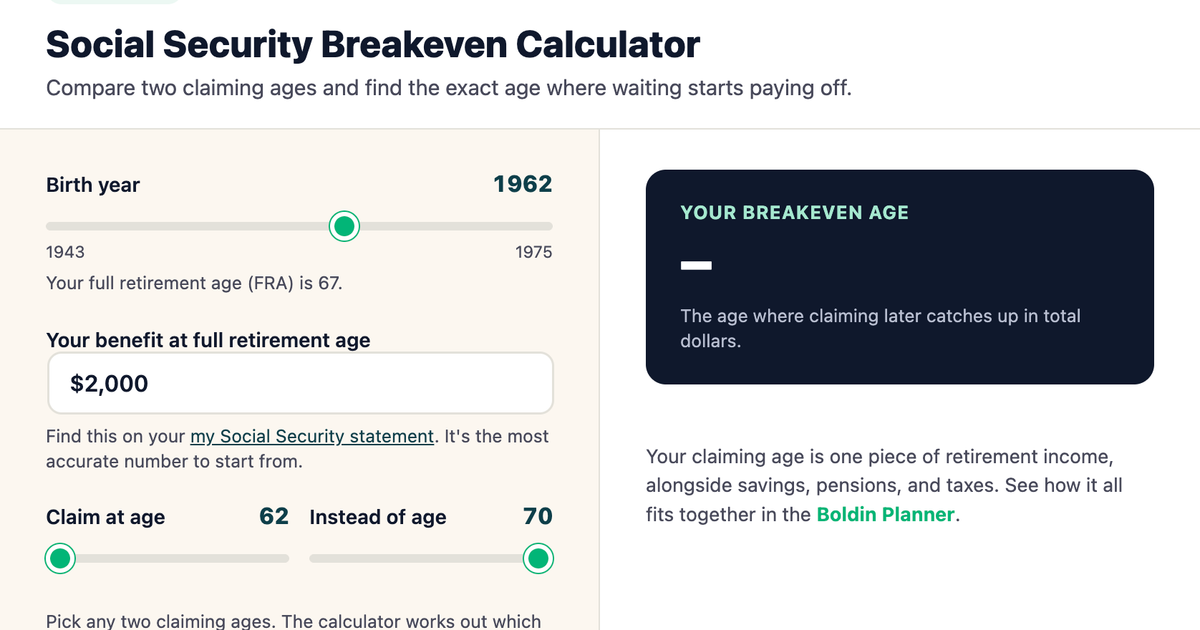
Social Security Breakeven Calculator
Compare two claiming ages and find the exact age where waiting starts paying off.
Birth year 1962 19431975 Your full retirement age (FRA) is 67. Your benefit at full retirement age Find this on your my Social Security statement. It’s the most accurate number to start from. Claim at age 62 Instead of age 70 Pick any two claiming ages. The calculator works out which one wins in total dollars, and at what age that changes. Estimate lifetime totals Estimate benefits through age 85 70100 A guess, not a prediction. Try a few different ages since this changes which claiming age comes out ahead. Your breakeven age – The age where claiming later catches up in total dollars. Your claiming age is one piece of retirement income, alongside savings, pensions, and taxes. See how it all fits together in the Boldin Planner.
This is an estimate, not your actual benefit. It applies the SSA’s exact early-claiming reduction and delayed-retirement-credit formulas to the full retirement age benefit you enter, so the percentages are precise. The dollar amounts are only as accurate as the benefit estimate you start with.
Figures are shown in today’s dollars and don’t include future cost-of-living adjustments, which raise benefits at every claiming age over time without changing which age comes out ahead. This tool doesn’t model spousal, survivor, or dependent benefits, the earnings test for working while claiming early, or taxes on benefits. Breakeven and lifetime totals ignore taxes and what you could otherwise earn by investing early benefit checks.
This tool runs the same math SSA uses. Enter your birth year, your benefit at full retirement age, and two ages you’re weighing. You’ll see your breakeven age, plus what each choice adds up to over time.
Note: The number won’t match your actual benefit down to the penny. Only SSA has your full earnings record. What this gives you is the tradeoff between any two ages you’re considering. If you haven’t pulled your number yet, setting up your online Social Security statement takes a few minutes.
How Does Your Claiming Age Affect Your Social Security Benefit?
Claiming before full retirement age permanently reduces your benefit. Waiting past it permanently increases your benefit, up to age 70.
The first three years you claim early cost more per month than any year after that. SSA front-loads the penalty, so the earliest months hurt the most.
Delayed retirement credits add a little to your benefit every month you wait, all the way to age 70. After that, there’s no reason to keep waiting. The credits stop.
How Is Your Social Security Benefit Calculated?
Your benefit comes from your 35 highest-earning years, run through a formula that favors lower earners.
SSA adjusts those 35 years for wage growth, then averages them into one monthly figure. Someone who earned less over their career gets a bigger share of their pay replaced.
That’s the short version. SSA fills in any missing years with zeros before running the full bend-point formula. That pulls your average down if you’re short of 35 years worked.
When Does Waiting for Social Security Pay Off?
Delaying your claim only pays off in total dollars if you live past a specific age. That age is usually in the early 80s, but it depends on your numbers.
Nobody can know how long they’ll live. That uncertainty is what makes this decision hard. The math, at least, is knowable. Live past your breakeven age and delaying your claim wins in total dollars. Pass away before it, and claiming early gave you more instead.
There’s no wrong answer here, only tradeoffs. Some people would rather have more money sooner, when they’re more likely to enjoy spending it. Others want the highest possible floor if they live long. Both count as good planning.
Health, income needs, or just wanting the money sooner all make a case for claiming as early as 62. A longer expected retirement or other income to lean on can make waiting until full retirement age the smarter math.
What Determines Your Full Retirement Age?
Full retirement age is 66 for anyone born 1943 to 1954. It rises in two-month steps, reaching 67 for anyone born in 1960 or later.
Birth years 1955 through 1959 sit in the middle of that climb. Each year adds two more months: 66 and 2 months in 1955, 66 and 10 months by 1959.
Get this number right first. Every reduction and every credit gets measured from it, so a wrong FRA throws off everything downstream.
Does This Calculator Account for Spousal or Survivor Benefits?
This calculator doesn’t account for spousal or survivor benefits. It only projects one person’s own benefit, and spousal, survivor, and dependent rules follow different math. Keep that in mind before you rely on these numbers for a shared decision.
Married couples have their own claiming rules. A spouse can claim up to half of the higher earner’s full retirement age benefit. Survivor benefits follow their own rules on top of that. Coordinating who claims first can change a couple’s combined benefit by a meaningful amount over a lifetime.
Raising kids under 18 changes the picture too. Dependent benefits can add a meaningful monthly amount per child until they turn 18.
Some careers weren’t covered by Social Security, common in government jobs. Those workers used to see their benefits cut further under a rule called WEP. That rule doesn’t apply anymore. Congress repealed it in 2025 through the Social Security Fairness Act. Anyone with a non-covered pension keeps their full benefit now.
What If You Want to Work While Claiming Social Security Early?
Working before full retirement age can temporarily reduce what you receive, though the withheld amount isn’t gone for good.
SSA withholds $1 for every $2 you earn above a yearly limit, $24,480 in 2026. That applies if you’re under full retirement age all year. SSA adds the withheld amount back into your benefit later, spread out over your remaining years. That recalculation doesn’t arrive as a lump sum. Instead, it permanently raises your monthly check.
Is Your Social Security Benefit Taxed?
Your Social Security check can be taxed once your total income crosses certain limits. As much as 85% can count as taxable income.
Lower earners can often pay nothing on their benefit at all. The exact income thresholds depend on your filing status and total income.
Is Social Security Enough for Retirement?
For most people, Social Security is not on its own. It was built to replace part of your income. Some retirees do make it work on Social Security benefits alone. The ones who pull it off often own their home outright and keep spending simple.
This decision connects to a bigger question for almost everyone. How does it fit with your savings and a pension, if you have one? What about how long your money needs to last? Want to see that fuller picture?
The Boldin Planner pulls your claiming age together with the rest of your retirement income. Once you’ve landed on an age, applying for Social Security is the next step, and it can be done online.
Frequently Asked Questions
What is the earliest age I can claim Social Security?
The earliest age is 62. Claiming that early comes with a permanent reduction, since it starts well before full retirement age. For someone with a full retirement age of 67, claiming at 62 cuts the monthly benefit by 30%, for life. That reduction can’t be undone later.
How much does claiming at 62 reduce my benefit?
The reduction depends on how many months early you claim. The first 36 months before full retirement age cost 5/9 of 1% each. Every month beyond that costs 5/12 of 1% instead. For a full retirement age of 66, claiming at 62 means 48 months early, a 25% cut in total. Someone with a later full retirement age sees a bigger cut at 62, since more months separate the two ages.
What is the breakeven age for delaying Social Security?
There’s no single answer. It depends on the two ages you’re comparing and your actual benefit amount. For the common comparison of claiming at 62 versus waiting until 70, the breakeven lands around age 80. Run your own numbers above, since your birth year and benefit shift the answer. Longevity and other income sources matter too, beyond the raw breakeven math.
Does my Social Security benefit keep increasing every year I wait?
Every month you delay past full retirement age adds about two thirds of one percent to your benefit. That growth continues only up until age 70, and works out to roughly 8% for a full year of waiting. The growth stops the moment you turn 70. That 8% growth rate is guaranteed, unlike market returns, which is one reason delaying appeals to more cautious savers.
Can I work while claiming Social Security early?
Nothing stops you from working while you claim Social Security, at any age. Before full retirement age, earnings above $24,480 in 2026 trigger withholding, $1 for every $2 over that mark. None of that withheld money disappears. SSA recalculates your benefit upward once you reach full retirement age, crediting you for the months withheld. The earnings limit disappears at that point too, so you can earn any amount from then on.
Will my Social Security benefit be taxed?
Your total income decides this, and Social Security is only one piece of it. Cross certain thresholds and part of your benefit becomes taxable, up to 85% at the federal level. Where those cutoffs land depends on your filing status. Some states skip this tax, so where you live matters too.
What is the Social Security COLA for 2026?
The 2026 cost-of-living adjustment is 2.8%, announced by the Social Security Administration in October 2025. It took effect with January 2026 payments, raising the average retired worker’s benefit by about $56 a month. COLA applies automatically to every benefit, no matter when you claimed it or how old you are. It’s separate from the claiming-age reduction or credit. Those lock in once, while COLA adjusts your check every year after that.