It is easy to believe that the majority of retirees relocate for retirement – move to Florida, take off for Mexico, buy on a golf course in Arizona or North Carolina. And, many prospective retirees definitely talk about it. However, residential mobility is not the reality.

In fact, the vast majority of retirees stay put. And, residential mobility is becoming increasingly uncommon for all Americans. Mobility has been steadily decreasing since a recent high in the 1980s. And, new research finds that today’s Americans who say that they intended to move are 45% less likely to have done so than people in the 1970s.
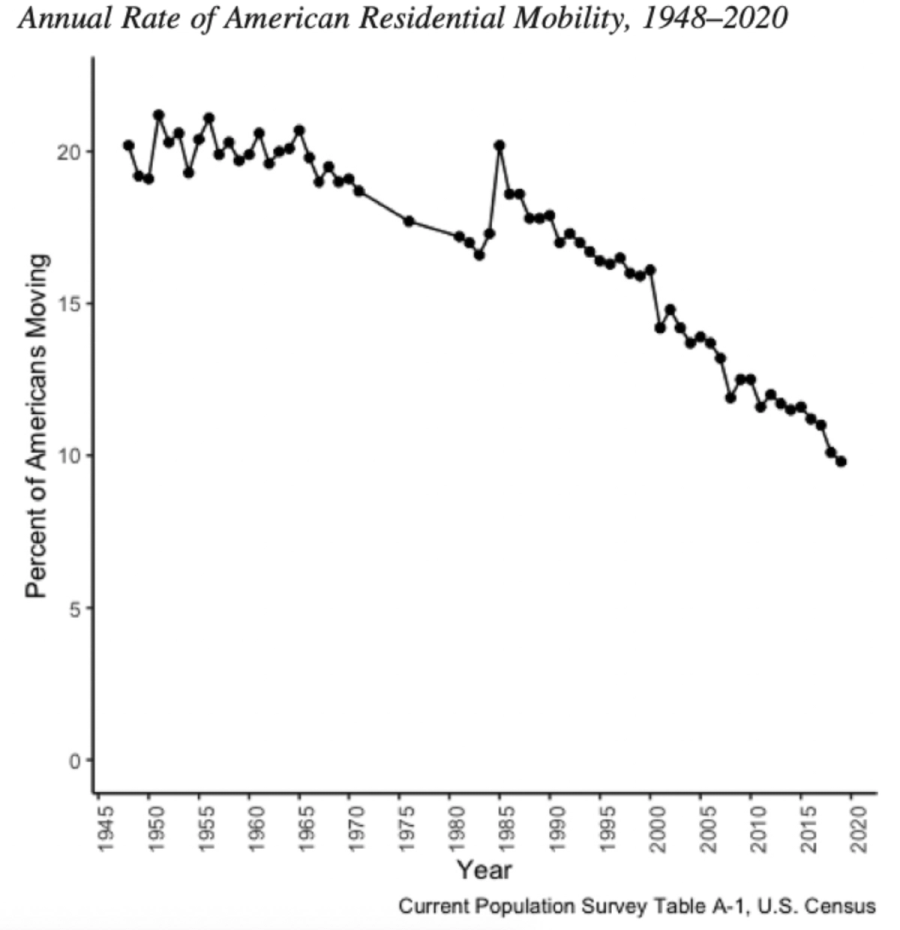
Staying put or aging in place is particularly true for retirees. According to AARP, only 29% of retirees plan to relocate for retirement. Sixty seven percent want to stay in the community where they currently live, and 63% want to stay in their existing home as long as possible.
Why Has Relocation and Mobility Stagnated?
Recent research published in American Psychologist looks at trends contributing to stagnation and the cultural dynamics of declining residential mobility.
The researchers believe that more and more people feel stuck. They say that, “Americans, it seems, are finding themselves increasingly locked into places that they wish to escape.”
The following trends may be contributing to making relocation harder:
- Housing prices.
- Red tape, especially regulations associated with occupational licensing requirements. (According to the Niskanen Center, around 25% of American workers need a state license to do their job. And, re-licensing in a new state can be costly and take a long time.)
- Zoning restrictions that limit housing supply in desirable locations.
According to researchers, wanting to — but feeling unable to move — leaves “people to wonder about whether their other efforts in life will be rewarded.” It leads to a defeatist approach to life.
The Benefits of Mobility
The researchers write about possible psychological implications of staying put, which may be particularly interesting to an aging population who wants to stay vital.
They theorize that there are negative cultural effects of residential stagnation and write that as mobility has gone down, levels of happiness, fairness and trust among Americans have also gone down.
While the researchers do not have evidence that stagnation causes a decline in happiness, fairness, and trust, they see a correlation in the trends and believe that moving may be a forcing function that enables renewal and a cascade of positive rewards like:
Freedom
When you move to a new location, you are forced to start fresh. In doing so you are defining yourself by your own personality traits, not by those you have surrounded yourself with.
And, being willing to consider relocating is a reflection of your ability to live life on your terms, finding the ideal locale and having the energy to take action on your dreams.
Financial Rewards
There is often a financial component to relocating – seeking a better job, higher pay, or a lower cost of living.
More Optimism and Risk Taking
Relocating is often associated with being more optimistic. It takes a leap of faith to relocate.
Moving is a risk, which can be positive – no risk, no reward after all.
More Open and Less Suspicious
When you relocate, you need to create new bonds which can naturally make you more open and accepting of new people. When you stay put, you have an existing network of people that you know and trust, which is great, but it can also cause you to be less open to new ideas and different kinds of people.
Opt into a Better Locale for Aging in Place
Most people want to stay as independent as possible for as long as possible. However, the family home may not be the best environment for old age. The AARP study found that of the people that want to move, 49% are looking for lower costs and a home that is easier to maintain.
Explore:
Benefits of Staying Put
Existing Connections
Family and friends are everything. If you have a well established network that you know and love and rely on, moving may be a non starter.
Most People Love Where They Live
The reality is that people love where they live. One study found that 81% of people are either somewhat or very attached to their current city. A Gallup study found that social offerings are — no matter where you live — the reason people love their community.
Social offerings vary by location, but people are attached to their community based on where they can meet up with people — parks, restaurants, museums, events, and more — and the feeling that people in the community care for each other.
What Do Your Location and Housing Plans Look Like In Your Retirement Plans?
Have you modeled a relocation as part of your Boldin Plan? What about using home equity as a way to fund retirement?
In addition to enabling you to model downsizing and relocation, the Boldin Retirement Planner enables you to model tapping home equity to help fund a long term care event, living expenses, or as a back up source of income during a financial downturn.
Try it out today. What do your finances look like when you consider your housing as an integrated part of your overall plan?
About Boldin
For people who want clarity about their choices today and their financial security tomorrow, Boldin is a financial planning platform that gives people the ability to discover, design and manage personalized paths to a secure future.
Our goal is to make high quality low cost financial guidance available to everyone. More than 155,000 people representing more than $168 Billion in wealth currently trust the system to make the most of their money and time. The platform is available to anyone online and through enterprise solutions. It can be co-branded or white labeled for partners. Additionally, the company provides API access to companies who wish to embed planning functionality within their own site.