The 2026 tax brackets run from 10% to 37% and apply to the federal return you file in early 2027. The 12% bracket starts above $12,400 of taxable income for single filers and $24,800 for married couples filing jointly. The 2026 standard deduction is $16,100 for single filers and $32,200 for joint filers.
If you’re retired or getting close, the brackets matter more than they did when a paycheck set your income. You now decide much of it: how much to pull from an IRA, whether to convert to Roth, and when to sell. Knowing where each bracket ends shows you how much room you have at each rate.
The IRS released the 2027 tax brackets on November 5, 2026. Thresholds rise about 3.2%, and the standard deduction climbs to $16,600 for single filers and $33,200 for joint filers. Both years are below, along with the extra deductions that start at 65.

What Are the 2026 Tax Brackets?
The 2026 federal tax brackets cover income you earn in 2026 and report on the return due April 15, 2027. Each rate applies to taxable income over the amount shown:
| Tax Rate | Single | Married Filing Jointly | Head of Household |
|---|---|---|---|
| 10% | Up to $12,400 | Up to $24,800 | Up to $17,700 |
| 12% | Over $12,400 | Over $24,800 | Over $17,700 |
| 22% | Over $50,400 | Over $100,800 | Over $67,450 |
| 24% | Over $105,700 | Over $211,400 | Over $105,700 |
| 32% | Over $201,775 | Over $403,550 | Over $201,750 |
| 35% | Over $256,225 | Over $512,450 | Over $256,200 |
| 37% | Over $640,600 | Over $768,700 | Over $640,600 |
Source: IRS Rev. Proc. 2025-32.
Only the income inside a bracket is taxed at that bracket’s rate. Take a married couple with $120,000 of taxable income in 2026. They pay 10% on the first $24,800, 12% on the next $76,000, and 22% on the last $19,200. Their federal income tax comes to $15,824.
That 22% is their marginal rate, the rate on their next dollar of income. Their effective rate, total tax divided by taxable income, is about 13.2%.
Taxable income is what’s left after deductions. The 2026 standard deduction is $16,100 for single filers, $32,200 for married couples filing jointly, and $24,150 for heads of household.
What Are the 2027 Tax Brackets?
The 2027 tax brackets cover income you earn in 2027, reported on returns filed in early 2028. The IRS set them in Revenue Procedure 2026-35, and thresholds rise about 3.2% from 2026:
| Tax Rate | Single | Married Filing Jointly | Head of Household |
|---|---|---|---|
| 10% | Up to $12,800 | Up to $25,600 | Up to $18,250 |
| 12% | Over $12,800 | Over $25,600 | Over $18,250 |
| 22% | Over $52,025 | Over $104,050 | Over $69,650 |
| 24% | Over $109,125 | Over $218,250 | Over $109,100 |
| 32% | Over $208,325 | Over $416,650 | Over $208,300 |
| 35% | Over $264,550 | Over $529,100 | Over $264,550 |
| 37% | Over $661,375 | Over $793,650 | Over $661,350 |
Source: IRS Rev. Proc. 2026-35.
The 2027 standard deduction is $16,600 for single filers, $33,200 for married couples filing jointly, and $24,925 for heads of household. The same couple with $120,000 of taxable income would owe $15,483 in 2027, about $340 less than in 2026. More of their income falls inside the 10% and 12% brackets.
What Extra Deductions Do People 65 and Older Get?
People 65 and older get two deductions on top of the standard deduction. The additional standard deduction has been in the tax code for decades. The senior deduction is a temporary $6,000 break added by the One Big Beautiful Bill Act:
| Deduction | 2026 | 2027 |
|---|---|---|
| Standard deduction, single | $16,100 | $16,600 |
| Standard deduction, married filing jointly | $32,200 | $33,200 |
| Standard deduction, head of household | $24,150 | $24,925 |
| Additional deduction, unmarried and 65+ | $2,050 | $2,100 |
| Additional deduction, married and 65+ (each spouse) | $1,650 | $1,700 |
| Senior deduction (each person 65+) | $6,000 | $6,000 |
Source: IRS Rev. Proc. 2025-32, Rev. Proc. 2026-35, and IRS guidance on the senior deduction. The additional deduction also applies to blind filers.
The senior deduction runs from 2025 through 2028, and you can take it whether or not you itemize. It shrinks by 6% of modified adjusted gross income above $75,000 for single filers or $150,000 for joint filers. Married couples must file jointly to claim it.
At full value, a married couple who are both 65 or older can deduct $47,500 in 2026 and $48,600 in 2027. A single filer 65 or older can deduct $24,150 and $24,700.
Income from a Roth conversion counts toward the phase-out, so the deduction can shrink in a big conversion year. That changes how much room you have for Roth conversions while the deduction lasts.
How Are Capital Gains Taxed in 2026 and 2027?
Long-term capital gains and qualified dividends have their own capital gains tax brackets: 0%, 15%, and 20%. Which rate applies depends on your taxable income, gains included:
| Rate and Filing Status | 2026 | 2027 |
|---|---|---|
| 0%, single | Up to $49,450 | Up to $51,050 |
| 0%, married filing jointly | Up to $98,900 | Up to $102,100 |
| 15%, single | Up to $545,500 | Up to $563,200 |
| 15%, married filing jointly | Up to $613,700 | Up to $633,600 |
| 20% | Above the 15% limit | Above the 15% limit |
Source: IRS Rev. Proc. 2025-32 and Rev. Proc. 2026-35.
A retired couple in a low-income year can sell appreciated shares and owe no federal tax on the gain. Taxable income, gain included, has to stay inside the 0% band.
Did the One Big Beautiful Bill Change the Tax Brackets?
The One Big Beautiful Bill Act, signed July 4, 2025, made the seven brackets from the 2017 Tax Cuts and Jobs Act permanent. The IRS now refers to its tax provisions as the Working Families Tax Cuts. Before it passed, most of the TCJA’s individual provisions were set to expire after 2025. The Tax Foundation estimated that about 62% of filers would have paid more.
The law also kept the larger standard deduction and raised the estate tax exemption to $15 million per person for 2026. It rises to $15.48 million in 2027. Some states set their own estate tax at much lower levels.
Three other provisions in the law shape retirees’ deductions:
- Senior deduction: $6,000 for each person 65 or older, for tax years 2025 through 2028.
- SALT cap: $40,400 for 2026, rising 1% a year through 2029 and dropping back to $10,000 in 2030. The higher cap phases down at incomes above $505,000.
- Charitable deduction for non-itemizers: up to $1,000, or $2,000 on a joint return, starting with 2026 returns. Gifts to donor-advised funds don’t qualify.
Permanent means no built-in end date. Congress can still change the tax code later.
How Do the Brackets Affect Retirement Tax Planning?
In retirement, you decide much of your taxable income each year by choosing which accounts to draw from. The brackets show how far you can go before the rate jumps. A couple filing jointly can have up to $100,800 of taxable income in 2026 and stay in the 12% bracket. In 2027, that rises to $104,050.
No employer withholds for you anymore, so paying taxes in retirement means setting up withholding or estimated payments. Five decisions interact with the brackets:
- Roth conversions. Converting enough to fill the 12% or 22% bracket moves money to Roth at a known rate. The years between retiring and starting Social Security or RMDs often have the most room, which makes conversion timing the key call.
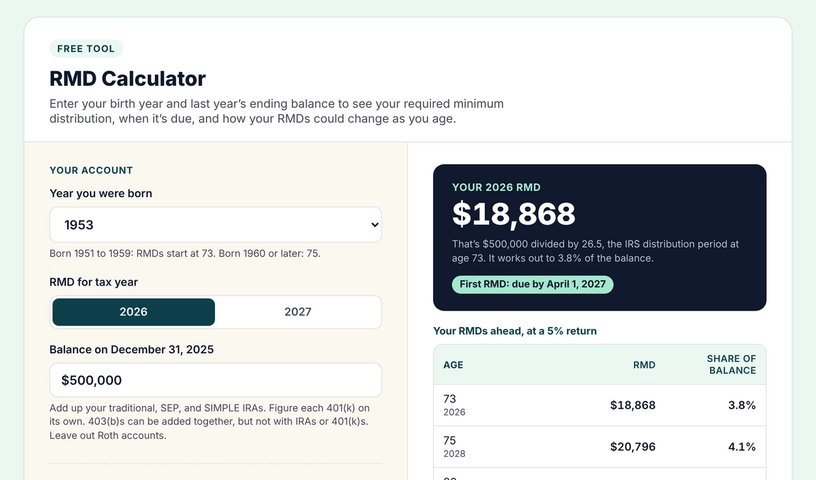
- Required minimum distributions. RMDs start at 73 for people born 1951 through 1959 and at 75 for those born in 1960 or later. They’re taxed as ordinary income, and shrinking them early can keep them from pushing you up a bracket. Qualified charitable distributions count toward an RMD and stay out of taxable income.
- Social Security. Up to 85% of benefits can be subject to income tax. Each extra dollar of IRA withdrawals can raise how much of your benefit is taxable.
- Medicare premiums. Income from two years earlier sets IRMAA surcharges, so a large 2026 conversion can raise premiums in 2028.
- State taxes. Federal brackets don’t set state income taxes, which range from zero to more than 13%.
The permanent rates make multi-year tax planning more predictable. The Boldin Planner projects your federal and state taxes for every year of retirement. You can compare withdrawal orders and Roth conversion amounts and see which bracket each plan lands in.
2026 and 2027 Tax Brackets FAQ
What tax bracket am I in if I make $100,000?
A single filer with $100,000 of income has $83,900 of taxable income in 2026 after the $16,100 standard deduction. That puts the top dollars in the 22% bracket. A married couple filing jointly with $100,000 has $67,800 of taxable income and tops out at 12%. Both land in the same brackets in 2027.
What is the standard deduction for seniors over 65 in 2026?
The standard deduction for a single filer 65 or older is $18,150 in 2026, combining the $16,100 base amount with a $2,050 add-on. A married couple who are both 65 or older get $35,500. The separate $6,000 senior deduction per person can lower taxable income further, depending on income.
When do the 2027 tax brackets apply?
The 2027 tax brackets apply to income earned from January 1 through December 31, 2027. You’ll use them on the federal return due in April 2028. Returns filed in early 2027 still use the 2026 brackets. Roth conversions and IRA withdrawals made during 2027 fall under the new thresholds.
Are tax brackets based on gross income or taxable income?
Federal tax brackets apply to taxable income. That’s adjusted gross income minus the standard or itemized deductions and other deductions, such as the senior deduction. A married couple under 65 with $90,000 of adjusted gross income has $57,800 of taxable income in 2026 after the $32,200 standard deduction. Only that $57,800 runs through the brackets.
Did the TCJA expire?
The Tax Cuts and Jobs Act’s individual provisions didn’t expire at the end of 2025. The One Big Beautiful Bill Act, signed July 4, 2025, made its seven tax rates, larger standard deduction, and higher estate tax exemption permanent. Thresholds still adjust for inflation, so the 2026 and 2027 brackets differ only in dollar amounts.
Do tax brackets change every year?
Federal tax bracket thresholds rise every year with inflation, and the IRS publishes the next year’s figures each fall. The rates stay at 10% to 37% unless Congress changes them. A household whose income stays flat pays a little less tax the next year, since more of that income falls in lower brackets.